

Double-D Ring vs Micrometric: Which Helmet Buckle Should You Ride With?
By Vamsi Aila5 min read
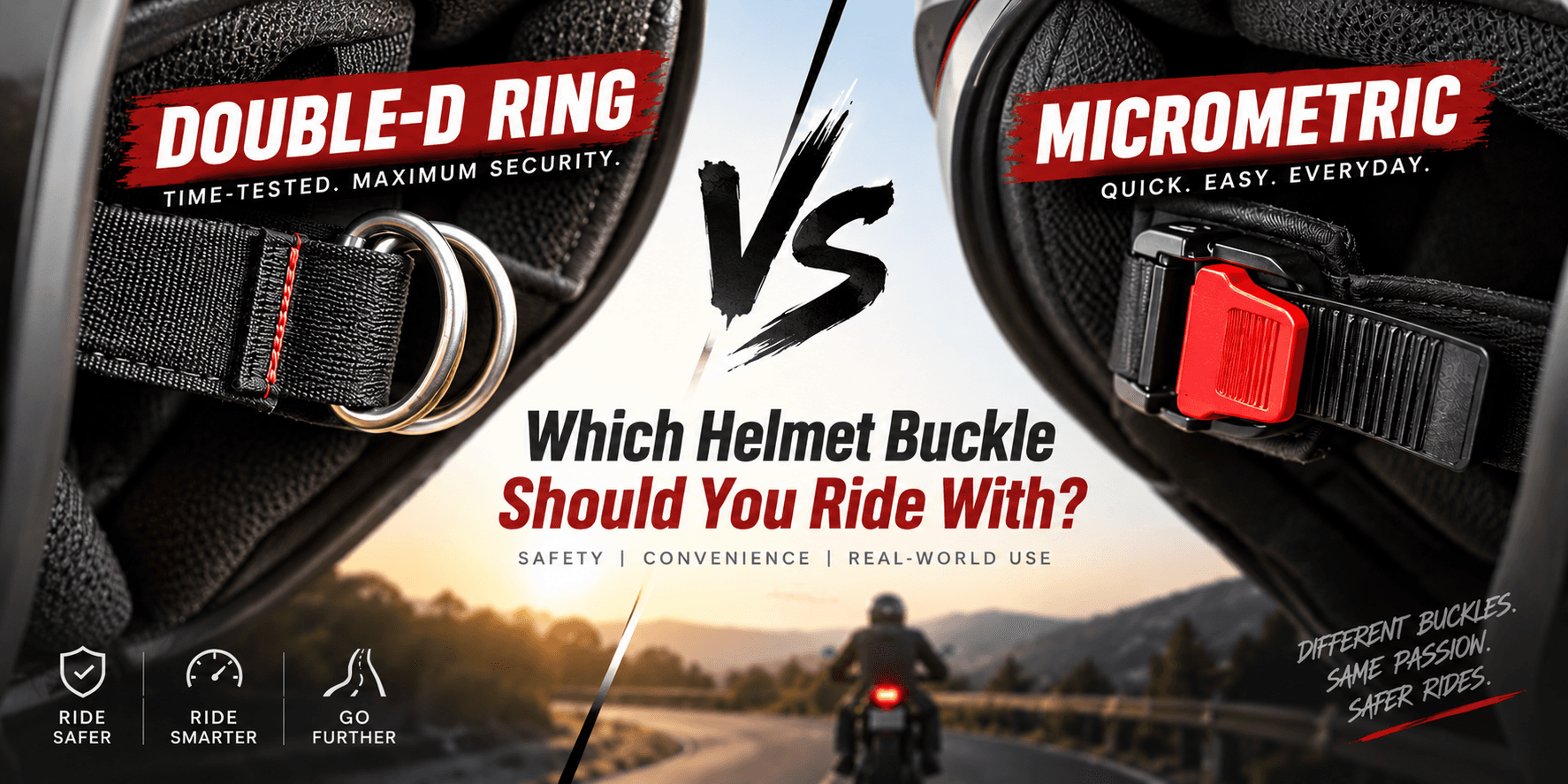
Every rider has a buckle opinion. Racers swear by the double-D ring. Commuters love the click of a micrometric. Both are legal, both are safe when used correctly, and both will get you killed if you don't actually fasten them. So the real question isn't which is "better" — it's which one you'll use properly every single time, in Palnadu heat, with sweaty hands, in a hurry to leave the tea stall.
The two systems, quickly
Double-D ring (often shortened to "D-ring") is two D-shaped metal rings sewn to one side of the chin strap. You feed the loose strap through both rings, back over the outer ring, through the inner one, and pull tight. A press-stud tucks the tail away. No moving parts. This is the design used on almost every track helmet in the world, and the only one accepted for competition by most racing bodies.
Micrometric (often called "micro-lock" or "quick-release ratchet") is a toothed plastic tongue on one side that slides into a spring-loaded metal or plastic catch on the other. Push in until it clicks, pull the red tab to release. You set the strap length once with a conventional adjuster; the ratchet then handles the last few centimetres.
There's also the seatbelt-style push-button buckle found on some cheap helmets. It has no fine adjustment and a plastic latch; if your helmet has one of these, it belongs in the "replace soon" pile.
Where the double-D ring wins
It cannot fail mechanically. There's nothing to wear out, jam with dust, or crack in the sun. A ten-year-old double-D ring works exactly like a new one.
It's self-tightening under load. In a crash, force on the strap pulls the rings tighter. That's why it remains the racing standard.
It fits perfectly every time. Because you pull the strap through by hand, the tension is whatever you set that morning — not one of eight fixed ratchet positions.
It's lighter and lower-profile. Less hardware under the jaw, which matters on long days when everything starts to rub.
Where the micrometric wins
Gloves. Try threading a double-D ring in winter gloves at 6 am on the way to Nallamala. You'll take the gloves off. A micrometric clicks shut with anything on your hands.
Speed. Fuel stops, photo stops, toll booths, the fifth chai of the day — a micrometric is two seconds on, one second off. Riders who find the double-D ring annoying end up riding with it loose, which is the actual danger.
Consistency for newer riders. A ratchet gives an audible click and a fixed position. There's no "did I thread it right?" moment. For someone's first helmet, that certainty is worth something.
Fine adjustment on the move. Strap slightly tight after lunch? One tooth looser, without stopping.
What the standards say
The ISI mark (IS 4151) and the European ECE 22.05/22.06 both allow either system, because both are tested on the retention system as a whole — the strap, the stitching and the buckle together must hold under the standard's load without the helmet rolling off. The buckle type is not what separates a good helmet from a bad one; the shell, the EPS liner, and whether it actually fits your head are.
What the standards can't test is the rider. A fastened micrometric and a fastened double-D ring perform about the same. A double-D ring threaded through only one ring because the rider was lazy, or a micrometric pushed in only one click, both fail.
How they age
Double-D ring: the strap webbing frays before the rings ever do. Check the stitching where the rings attach every few months; that's the weak point.
Micrometric: the plastic tongue wears at the teeth, the spring in the catch loses bite, and dust from off-road riding gets in. Most manufacturers say to inspect it yearly and replace the helmet at five years regardless. If the tab ever releases with less than a firm pull, stop trusting it.
What we'd tell a new Sipahi
- Buying your first helmet? Micrometric. You'll fasten it properly every time, and that beats a "better" buckle you leave loose.
- Doing track days or serious high-speed touring? Double-D ring, and practise until you can thread it blind.
- Long adventure rides with gloves? Micrometric, or a double-D ring with a pull tab you can grab in gloves.
- Already own a double-D ring helmet? Keep it. Just learn the routine: through both rings, back over one, pull, snap the stud. Thirty seconds of practice removes the only real disadvantage.
Whichever you ride with, the rule is the same: the buckle is closed before the side stand goes up. No exceptions, no "just to the corner". A ₹15,000 helmet with an open strap is a very expensive hat.
Ride safe. Two wheels, four wheels, any terrain.
0 comments
Loading comments…
More in Road safety · All articles